
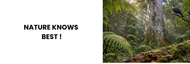
Nature Knows Best
Posted by otaki@nznaturalclothing.co.nz BigCommerce on 8th Nov 2026
Nature Knows Best: The Remarkable Things We Take for Granted
We live in a country surrounded by some of nature's most remarkable creations, yet how often do we stop to appreciate what's right under our noses? From the extraordinary insulating properties of a bird's feathers to the clever ways native plants have adapted to survive New Zealand's ever-changing climate, nature has been quietly perfecting its designs for millions of years.
And the remarkable thing is that nature doesn't need instruction manuals, complicated machinery or the latest technology to get the job done. It simply adapts, evolves and finds a way. Often, the very things we humans spend years trying to develop have been happening naturally right under our noses.
So, we thought we'd take a little wander through the natural world and share five fascinating examples of nature's ingenuity. Some you may already know, while others might just have you looking at your surroundings a little differently.
1. Feathers: Nature's Very Own Insulation System
Have you ever wondered how birds manage to stay warm when they're perched on a branch in the middle of winter, seemingly unbothered by the cold?
The secret lies largely in their feathers. Beneath the outer layer of protective feathers, many birds have soft, fluffy feathers that trap pockets of air close to their bodies. This trapped air helps reduce heat loss, providing an incredibly effective form of natural insulation.
Birds can even fluff up their feathers to increase the amount of air trapped between them, rather like adding another layer of insulation when temperatures drop.
And here's another interesting fact: many birds have a special gland near the base of their tail that produces oil, which they spread over their feathers while preening. This helps maintain their feathers and, in many species, contributes to water resistance.
Nature's lesson? Sometimes the best way to stay warm isn't to add weight, but simply to trap air in the right places.
2. The Humble Fern: A Survivor from Another Age
Take a walk through almost any patch of New Zealand native bush and you're likely to encounter a fern. They're so familiar that we barely give them a second thought.
Yet ferns are among the oldest groups of plants still thriving on Earth, with ancestors dating back hundreds of millions of years, long before flowering plants became widespread.
New Zealand is home to an extraordinary variety of ferns, from delicate ground-dwelling species to towering tree ferns that create the unmistakable character of our native forests.
Unlike flowering plants, ferns reproduce using spores rather than seeds. These tiny reproductive structures are often found on the undersides of their fronds and can be dispersed by the wind.
Many ferns also have a rather clever way of protecting their developing fronds. Their young leaves emerge tightly coiled, gradually unfurling as they grow. This familiar spiral shape, known as a koru in Māori, has become one of New Zealand's most recognisable natural symbols.
Nature's lesson? You don't necessarily need to reinvent yourself to survive. Sometimes a good design, refined over millions of years, is more than enough.
3. Tree Bark: Much More Than Just a Protective Coat
Most of us probably wouldn't give the bark of a tree much consideration. After all, it's just the rough stuff on the outside, isn't it?
Well, not quite.
Bark is an important part of a tree's defence system, helping protect the living tissues beneath it from physical damage, temperature extremes, insects and disease.
Some trees develop thick bark that provides a degree of protection against fire, while others have bark containing naturally occurring compounds that help discourage insects or harmful microorganisms.
Bark also plays a role in the wider environment. Its cracks and crevices provide shelter for insects, spiders, mosses, lichens and other small organisms.
Even after a tree dies, its bark and wood continue to contribute to the natural cycle, gradually breaking down and returning nutrients to the soil.
Interestingly, researchers are also exploring ways to make better use of bark from forestry operations, extracting valuable natural compounds and developing alternatives to some petroleum-based materials.
Nature's lesson? What looks like a simple outer covering can actually be a sophisticated protective system, and even what we might consider waste can have another useful purpose.
4. The Incredible Engineering of a Spider's Web
Now, spiders might not be everyone's favourite creatures, particularly when one appears unexpectedly in the bathroom, but there's no denying they're remarkable little engineers.
Spider silk is an extraordinary natural material. Depending on the species and type of silk, it can combine impressive tensile strength with remarkable flexibility.
A spider doesn't simply produce one kind of silk, either. Many species manufacture several types, each suited to a particular job, from constructing webs and wrapping prey to creating protective egg sacs.
And those beautiful circular webs we sometimes see glistening with morning dew? They're carefully constructed structures designed to catch insects while using relatively little material.
Perhaps most remarkably, spiders produce their silk using proteins made within their own bodies, without the industrial temperatures or manufacturing processes we associate with producing high-performance materials.
Scientists have spent years studying spider silk in the hope of developing new materials inspired by its unusual combination of properties.
Nature's lesson? Strength doesn't always mean being thick, heavy or rigid. Sometimes the cleverest designs are light, flexible and surprisingly simple in appearance.
5. Nature's Recycling System: Nothing Goes to Waste for Long
If there's one thing nature has become particularly good at, it's making use of what is left behind.
Take a fallen tree in the forest. To us, it might look like something that has reached the end of its useful life. But to the forest, it's the beginning of an entirely new chapter.
Fungi, bacteria and countless tiny organisms gradually break down the dead wood, releasing nutrients back into the surrounding environment. Insects make their homes within it, mosses establish themselves on its surface, and eventually new plants may begin growing from the decaying remains.
Even fallen leaves play an important part in this process, helping build organic matter in the soil and supporting the next generation of plant life.
It's a fascinating natural cycle in which the remains of one living thing become resources for another.
Of course, nature isn't entirely waste-free, and these processes can take years or even decades. But the ability of natural ecosystems to reuse and recycle materials is something we humans could certainly learn a thing or two from.
Nature's lesson? Just because something has finished one job doesn't necessarily mean it has nothing left to offer.
Perhaps Nature Really Does Know Best
When you stop and consider the extraordinary things happening around us every day, it's difficult not to be impressed.
From the insulating feathers of a tiny bird to the intricate engineering of a spider's web, nature has developed solutions to problems that humans are still working to understand.
And perhaps that's the most interesting part of all. While we're busy inventing, manufacturing and improving, the natural world has been quietly demonstrating some remarkably effective ideas for millions of years.
Here at New Zealand Natural Clothing, we've always had a healthy appreciation for what nature provides. After all, natural fibres are a big part of what we do. But our admiration for the natural world certainly doesn't stop at what we wear.
So next time you're out enjoying a little fresh air, take a moment to look around. That fern beside the track, the bird perched on the fence or even the spider busy building its web might have a rather interesting story to tell.
Because sometimes the most remarkable things in life are the very ones we take for granted.
Thanks for reading
Phil, Julie and the NZNC team